
Can one simple shift in how you collect data change your strategy—and your results? Many leaders assume the two studies are the same. But they serve different goals and tell different stories.
Britannica defines market research as the study of needs across various markets and how products are accepted. In practice, this means companies gather broad information to shape marketing and business plans. By contrast, studies focused on specific clients dig into behaviors and preferences to refine product offers and service.
We will show how to conduct market research that informs strategy and how targeted analysis of people yields actionable insights. Expect clear methods, types of surveys, and steps to turn data into better decisions for businesses of every size.
Key Takeaways
- Know the goal: broad studies guide strategy; client studies guide product fit.
- Use both methods—each fills gaps the other misses.
- Surveys and analytics deliver the data you need to act.
- Clear steps help companies collect cleaner information and faster results.
- Smart analysis turns inputs into competitive insights.
Defining Market Research vs Customer Research
Clear definitions keep strategy grounded—let’s separate broad analysis from focused client studies.
Market research surveys broad patterns across segments, trends, and product acceptance. It answers what areas show demand and which channels work best. Use this to shape high-level marketing and business plans.
“Market research is the study of the requirements of various markets, the acceptability of products, and methods of developing or exploiting new markets.”
Defining Market Research
This type of study collects wide-angle data on trends, competitors, and category performance. Teams measure sizes, needs, and product fit so companies can prioritize strategies and investments.

Defining Customer Research
Customer research is a focused subset that studies the behaviors and preferences of your target customers. It digs into use cases, satisfaction, and service expectations.
Why use both? Combine broad and narrow work so your product and service decisions match both demand and real preferences.
- Identify trends and competitive gaps.
- Gather direct input to tailor products and services.
- Align marketing and company strategies with actionable insights.
For a deeper comparison, see customer insights vs market research.
The Core Purpose of Market Research
At its core, studying a whole market clarifies whether a new offering will meet broad demand and reach enough buyers to justify investment.
Tony Oduor, GeoPoll’s Research Manager, notes that this work looks at entire segments so companies can make informed business decisions.
The primary goal is simple: answer critical questions about demand and spot emerging trends. Firms analyze needs across a segment to reduce risk and align with industry standards.

For example, a company might conduct market research to test demand before it commits capital. This approach gives leaders the data they need to navigate competition and prioritize investments.
| Purpose | Key Question | Example |
|---|---|---|
| Assess demand | Is there enough interest to support a new product? | Pre-launch surveys and size estimates |
| Spot trends | Which shifts could affect long-term growth? | Trend analysis and competitor tracking |
| Guide decisions | Where should we invest time and capital? | Segment prioritization and forecasts |
Tip: Use both broad analysis and focused insights. To learn how to set up a structured program, see this market research guide.
Understanding the Role of Customer Insights
Understanding how people feel and act gives teams the context numbers alone cannot deliver. Start with clear goals so the work guides product and marketing choices.
The Human Perspective
Customer insights provide the human angle that market research often lacks. They explain the “why” behind behaviors and reveal feelings about your products services and brand.
When you analyze the results of your research, you see how people react to service and product changes. That information points to specific fixes—often the ones that lift loyalty and sales.

For example, broad market research might show a drop in sales. Customer insights can reveal that slow support response time caused the decline.
Businesses use those insights to answer key questions about retention and to build marketing strategy that resonates. The data helps companies refine offers to meet evolving needs and deliver better results.
Key Differences in Scope and Focus
At its heart, the difference is breadth versus depth. One approach examines the whole market to spot trends and size opportunities. The other digs into real behavior to explain why people act the way they do.
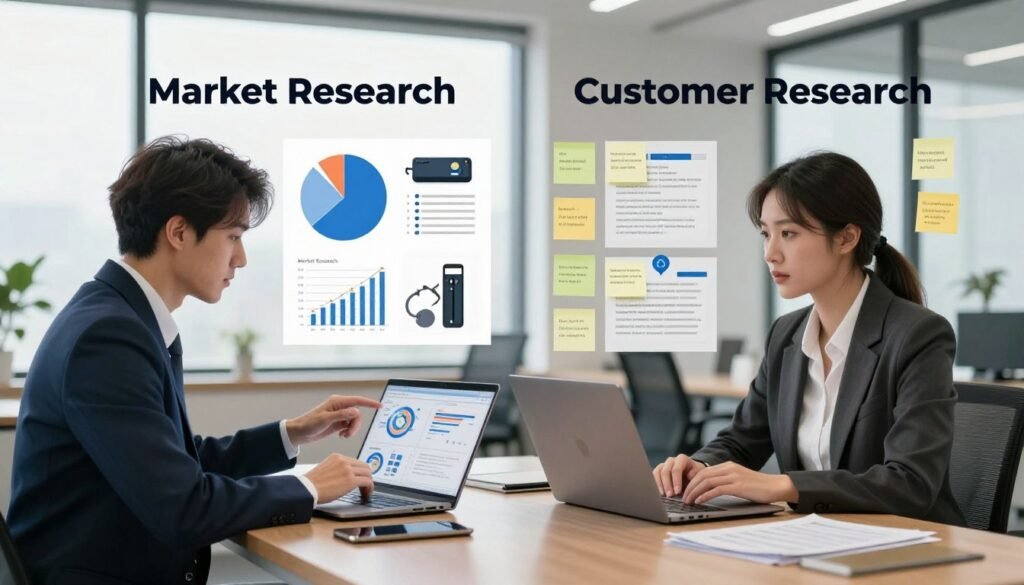
Why this matters: businesses need the right mix so marketing and product choices rest on accurate data. Broad studies give context; focused insights deliver the details that drive product fixes and better experiences.
- Scope: market research looks wide; focused work looks deep.
- Strategy: use broad data for planning and narrow insights to refine tactics.
- Balance: companies that blend both adapt faster to changing market trends.
Maintain a clear focus on both macro and micro levels. Integrate these types of information into one strategy. That combination gives you the actionable insights needed for long-term business success.
Primary Research Methods for Market Analysis
Start with direct sources when you need fresh, specific answers to support decisions.

Primary Research
Primary research means collecting raw data from real people. Surveys, interviews, and field testing reveal current behaviors and demand.
Use short surveys for numeric results. Use interviews and focus groups for deeper insight into why people act a certain way.
Secondary Research
Secondary research uses existing reports, public records, and past studies. It saves time and gives context for primary work.
Combine secondary sources with fresh data to validate trends and benchmark performance for your product or services.
Qualitative vs Quantitative
Qualitative methods—like focus groups—surface feelings and stories. Quantitative methods—like surveys—deliver numbers and clear metrics.
“Good strategies pair both types so companies can interpret numbers alongside real voices.”
Tip: Blend methods to get comprehensive data collected and convert results into practical insights for marketing and product decisions.
Techniques for Gathering Customer Data
Good insights start with what you already own. Track internal sales and CRM logs to spot who buys, when, and why.
Capture service feedback from support tickets and chat transcripts. Those notes reveal friction and feature requests.

Use direct surveys and short polls to test hypotheses. Pair them with analytics to validate behavior.
- Sales tracking: reveals trends in purchases and recurring revenue.
- Support feedback: uncovers usability issues in your product service.
- Surveys & polls: gather targeted information on needs and intent.
Combine primary research and secondary research to fill gaps. External reports add context; your own data brings clarity.
When companies mix methods, they move beyond surface metrics. The data collected then shows motivations behind buying. That leads to better product choices and higher satisfaction.
How Data Informs Business Decisions
Good data turns opinions into clear, testable steps that leaders can act on right away.
Turning numbers into action starts with a clear question. Decide what you need to know—about sales, product fit, or your brand—and collect the right information.
For example, analyzing sales trends can show whether to launch a new product or change pricing. Use that insight to create a short test and measure results.

Turning Data into Action
Move from analysis to action in three steps: interpret, prioritize, and execute. First, turn raw data into readable insights.
Next, prioritize based on impact and effort. Small tests can answer big questions quickly. Then, assign owners and timelines so results lead to change.
“Effective research is the foundation of every successful business — it replaces guesswork with a clear path forward.”
- Interpret: Translate charts and feedback into clear options.
- Prioritize: Choose tests that answer the most urgent questions.
- Act: Run small experiments, measure outcomes, and scale winners.
When companies make these steps routine, people across the organization make better decisions. The result: stronger strategy, improved marketing, and measurable business results.
The Four Ps of Marketing Framework
A simple Four Ps framework helps teams move from insights to better positioned products and offers.
The Four Ps — Product, Price, Place, Promotion — provide a clear way to apply analysis to your marketing strategy.
Product: Use market research and primary research to define features, packaging, and value. This ensures your products and services meet actual needs and demand.
Price: Use surveys and secondary research to set competitive pricing. Test price bands to balance margin with conversion and sales.
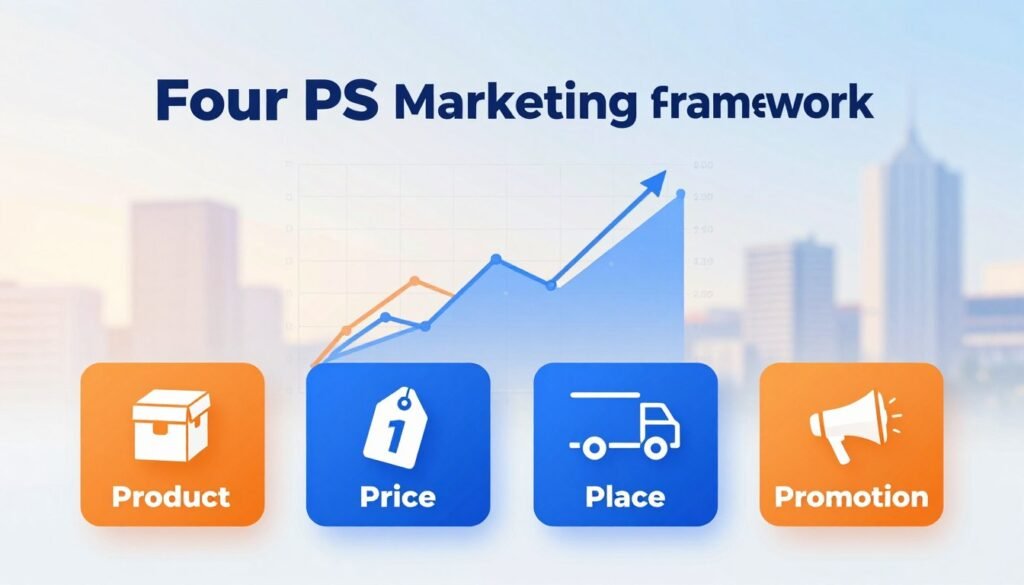
Place: Distribution choices come from broad study and channel analysis. Use findings to place products where your target audience shops.
Promotion: Qualitative research is useful here. It reveals brand perception and whether campaigns move the needle.
“Apply both primary and secondary methods so your marketing mix matches real demand and drives measurable results.”
- Combine methods to refine strategy and improve results.
- Focus on the Four Ps to align product offerings and promotional methods with target needs.
- When you connect insights to each P, companies see better positioning and increased sales.
When to Prioritize Each Research Type
Choose the method that answers your immediate decision need—broad signals or deep behavior.
Businesses should conduct market research when they explore new opportunities, forecast demand, or track emerging market trends. Use wide studies to size opportunities and spot shifts before you invest.
Prioritize marketing research when you must boost campaign performance or strengthen brand engagement with your customers. Short surveys and behavioral tests help tune messaging and channels fast.

How to decide:
- Run broad studies to answer questions about demand, segment size, and long-term trends.
- Run targeted work to fix product issues, improve service, or test pricing and offers.
- Combine both when stakes are high—validate wide signals with direct insights.
Bottom line: Prioritizing the right type at the right time helps companies make better business decisions. It keeps data relevant, actionable, and focused on outcomes that drive growth.
Leveraging Professional Research Services
Expert services translate noisy inputs into reliable insights that improve strategy.
When you work with firms like GeoPoll, you tap into experience across fast-moving consumer goods, media houses, consulting firms, banks, and tech companies.
That access matters. Professional teams use advanced methods and broad samples you may not reach on your own. They also run qualitative research and surveys that deliver clear results.

Partnering with specialists helps you refine product service offers. It answers hard questions about your brand and how people perceive your products services.
Why hire professionals? You get accurate data collection, deeper analysis, and guidance to implement better strategies. For many businesses, the cost is an investment in reliable decisions.
- Access: advanced methods and hard-to-reach samples.
- Accuracy: cleaner data and consistent analysis.
- Action: insights that shape product service strategies and tests.
| Benefit | Use Case | Expected Result |
|---|---|---|
| Advanced methods | Qualitative research and segmented surveys | Deeper understanding of perceptions and behaviors |
| Broader samples | Global FMCG and financial studies | Representative data for confident decisions |
| Operational support | End-to-end data collection and analysis | Faster, actionable results and tested strategies |
Synergizing Data for Strategic Growth
Combining broad trend signals with direct user feedback creates a roadmap for smarter growth. When you blend market signals and targeted research, you get clearer insights that guide product and brand choices.
This unified view helps your company make faster, better decisions. Use the combined information to prioritize features, refine pricing, and sharpen messaging.

Professional methods make integration repeatable. Qualitative interviews, segmented surveys, and analytics pipelines turn raw data into reliable inputs for strategy.
The payoff: aligned products and services that evolve with user needs. That alignment makes the company more resilient and improves long-term results.
| Benefit | What it connects | Expected result |
|---|---|---|
| Clear priorities | Market signals + user insights | Faster product decisions |
| Better positioning | Brand inputs + feature feedback | Higher relevance and conversion |
| Consistent execution | Professional methods + data pipelines | Reliable, repeatable results |
Conclusion
A balanced approach turns wide signals and direct feedback into practical steps for growth.
Use broad studies to set direction and short, targeted work to refine offerings. That mix helps your team spot shifts and fix what matters fast.
When companies pair both types of research, they get clearer insights and faster outcomes. This approach keeps your brand relevant and improves product and service choices.
Act now: integrate findings into your strategy, run small tests, and scale what works. Doing so helps companies stay agile and use insight-driven choices to win.
FAQ
What is the difference between market research and customer research?
How do you define market research?
How is customer research defined?
What is the main purpose of market-focused studies?
Why are customer insights important for product teams?
How do scope and focus differ between these approaches?
What are the primary methods for gathering industry-level data?
What is secondary research and when should you use it?
How do qualitative and quantitative approaches differ?
What techniques work best for collecting customer data?
How do teams turn data into action?
How does the Four Ps framework fit into these studies?
When should a business prioritize industry analysis over customer listening?
When is it worth hiring professional research services?
How can companies combine different data sources for strategic growth?
Ashok Nandi is an author at WhoShouldIGoWith.com, where he writes research-led comparison guides, buyer education articles, industry explainers, and best-of rankings across emerging and competitive markets. His work focuses on helping readers understand complex choices with greater clarity by studying market trends, brand positioning, customer needs, service models, and the factors that separate strong providers from the rest.
At WhoShouldIGoWith.com, Ashok brings a structured, analytical approach to every article. He breaks down crowded markets into simple, useful insights so that readers can compare companies, platforms, products, and service providers with more confidence. His writing is designed to be clear, practical, and decision-focused, making it especially useful for buyers, families, founders, professionals, and business leaders who want to make informed choices without getting lost in vague claims or marketing noise.
Ashok’s articles often combine market research, category analysis, practical buying criteria, and easy-to-follow explanations. Whether he is reviewing learning platforms, business services, technology providers, or consumer-facing solutions, his goal is to help readers understand not just which options stand out, but why they stand out.
Through his work at WhoShouldIGoWith.com, Ashok contributes to the firm’s mission of making high-quality market research easier to access, easier to read, and easier to act on.