
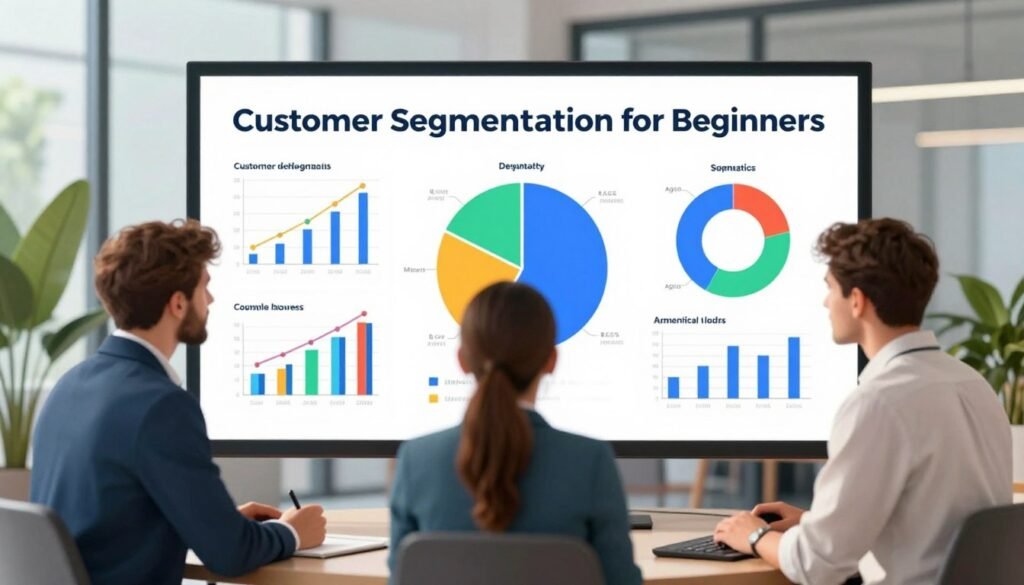
Do you really know who buys your products—and why? This guide helps you turn raw data into clear groups so you can tailor marketing and improve sales. We start simple and build practical steps you can use today.
Customer segmentation is the practice of splitting your customer base into groups so you can match offers to real needs. Think of a small coffee-roasting business. One campaign won’t fit local cafes, online shoppers, and wholesale buyers.
By grouping buyers, you deliver the right product or service to the right people at the right time. Research shows 65% of customers expect companies to adapt as they interact with a brand. That expectation makes smart analysis and analytics essential.
Key Takeaways
- Segmentation helps you target marketing with clear, actionable groups.
- Use simple data and behavior analysis to refine offers and campaigns.
- Adapting to customer needs builds loyalty and boosts sales.
- Even small businesses can use segments to reach new markets.
- This guide provides analytics and strategies to improve performance.
Understanding the Basics of Customer Segmentation
Breaking your audience into clear groups turns scattered data into usable marketing actions. This process groups buyers by shared traits — demographics, purchase behavior, or product use — so you can align offers to real needs.
Why it matters: 61% of customers say most companies treat them like a number. That gap is an opportunity. Use analytics to spot where your product or service fits best for each group.
For example, a maker of high-performance laptops can split buyers into casual gamers and high-end hardware enthusiasts. Each group expects different features, messaging, and pricing.
How to start: collect simple data, run basic analysis, and build two to four personas. Personas guide your campaigns and show where to spend time and ad budget.

| Step | What to Gather | Purpose |
|---|---|---|
| 1. Data collection | Purchase history, demographics | Find patterns in behavior |
| 2. Analysis | Analytics reports, surveys | Define actionable groups |
| 3. Personas | Profiles for top segments | Guide messaging and campaigns |
Why Your Business Needs a Segmentation Strategy
Grouping buyers by value and behavior helps teams spend time and budget where it matters most. A clear strategy points your marketing and sales to the highest-return groups. Use data to spot the top 20% that drive about 80% of results—this is the 80/20 rule in action.

Improving Customer Experience
Tailored experiences win repeat purchases. When you treat buyers as individuals, service and messaging fit real needs.
Practical benefit: faster purchase decisions, fewer returns, and higher perceived value.
Boosting Long-Term Loyalty
Data reveals which groups show higher lifetime value. Focus your sales team on those segments and you get better retention.
Result: optimized marketing spend, stronger brand affinity, and steady sales growth.
| Focus Area | Action | Why It Matters | Quick KPI |
|---|---|---|---|
| High-value groups | Prioritize offers and outreach | Drives most revenue | Revenue share from top 20% |
| Experience tuning | Personalize service & messaging | Reduces friction and returns | Repeat purchase rate |
| Behavior tracking | Monitor purchase patterns | Adapts products to needs | CLV and retention |
| Sales enablement | Equip reps with insights | Shortens sales cycles | Conversion rate |
Core Methods for Grouping Your Customer Base
Choose practical methods that match how people buy and what they need. Start with simple categories you can measure. Then add layers to sharpen your outreach.

Demographic and Geographic Traits
Demographic traits—age, gender, and income—help you predict buying patterns. Use these to design offers that fit likely budgets and interests.
Geographic traits—city, state, or preferred language—ensure your team targets people who can access your products or services.
Behavioral and Psychographic Insights
Behavioral grouping tracks actions: pages visited, repeat purchases, or abandoned carts. These signals guide timely campaigns.
Psychographic insights capture interests and values. Combine them with simple demographics to build richer personas for your marketing.
Technographic and Value-Based Grouping
Technographic data shows preferred devices and platforms. Tailor outreach by device type and browser for better engagement.
Value-based grouping ranks buyers by purchase value and satisfaction scores. Focus sales and marketing where it raises lifetime value.
| Type | What it uses | Key benefit |
|---|---|---|
| Demographic & Geographic | Age, income, location | Faster targeting for local offers |
| Behavioral & Psychographic | Actions, interests, values | More relevant messaging |
| Technographic & Value | Device, spend, CLV | Higher conversion and loyalty |
How to Build Your Segmentation Process
Design a repeatable process that turns raw analytics into useful buyer profiles and clear next steps.
Start by defining buyer personas. Use what you already know—purchase patterns, product use, and basic demographics. These personas guide what data to collect and which tests to run.
Bring sales and marketing into planning. Their insights make the strategy realistic and actionable. Set a clear goal—enter a new vertical, lift brand awareness, or improve loyalty. Goals determine how you group people and which metrics matter.
Gather information with surveys, reviews, and social listening. Then run analysis in your analytics tools. Use machine learning or AI in sales platforms to find hidden links between groups and behavior.
Allow a time frame—months or a quarter—to gather enough data. Compare the new group’s performance against your overall base. Refine by creating sub-groups when a pattern proves valuable.
Result: marketing campaigns backed by reliable data, better targeting of offers, and improved lifetime value for your business.

Leveraging Data to Refine Your Customer Segments
Refining groups starts with collecting the right signals—both what people say and what they do. Use direct feedback and behavior data together to form precise profiles that guide marketing and sales.
Direct and Indirect Data Collection
Direct data comes from surveys and post-purchase questionnaires. These responses reveal experience, needs, and product preferences in your market.
Indirect data means tracking actions—purchase history, site activity, and social mentions. These signals show real patterns and predict future value.
Evidence matters: an Optimove study of 30 million customers found smaller, targeted groups often deliver a bigger campaign uplift. Combine demographics with real-time behavior to create a holistic view.
Update segments on a regular cadence. When data stays fresh, you can see how customers move between groups. That lets you close experience gaps and boost loyalty.

| Source | What it Shows | Action |
|---|---|---|
| Surveys & Feedback | Experience, needs | Refine messaging and offers |
| Purchase History | Value and patterns | Prioritize high-value groups |
| Web & App Behavior | Real-time intent | Trigger timely campaigns |
| Unified CRM | Shared sales & marketing view | Improve targeting and performance |
Common Pitfalls to Avoid When Segmenting
Rushing into group definitions without strong evidence invites wrong targeting and missed revenue. Don’t skip segmentation; a one-size-fits-all approach wastes ad spend and weakens your message.
Poor data sources are a frequent cause of failure. Bad inputs produce bad analysis and send the wrong signals to your sales and marketing teams.
Another risk is basing groups on gut feeling. Assumptions create inaccurate segments that harm performance and the brand.
Sending irrelevant offers is costly. For example, an “upgrade now” email to enterprise buyers can erode trust and lift unsubscribe rates.
We recommend regular audits of your strategy. Test small samples through your process to find misalignments before you scale campaigns.

- Fix the source: invest time in deliberate, high-quality data collection.
- Validate: run analytics tests on sample customers to confirm results.
- Audit: schedule cadence reviews to catch drift and keep segments useful.
Essential Software Features for Scaling Your Efforts
Scaling effective outreach depends on tools that prepare and activate your data. Use software to remove manual work so teams can focus on strategy.
Automated data preparation aggregates behavior from sales platforms, web analytics, and CRM systems into unified profiles. This creates a single view for each customer and speeds analysis.
Sales personalization tools connect marketing and sales workflows. They push relevant context into a rep’s CRM so outreach matches a prospect’s journey and increases conversion.
Real result: Musti used automation to run ultra-targeted campaigns—89% of their sends targeted less than 0.02% of their customer base.

- Journey orchestration: build cross-channel experiences—email, SMS, calls—based on triggers.
- Email productivity: surface segment data inside the inbox for timely messages.
- AI insights: predict lifetime value and spending trends beyond observable behavior.
| Feature | What it does | Why it matters | Key metric |
|---|---|---|---|
| Automated data prep | Unifies profile data from multiple sources | Speeds analysis and reduces manual errors | Time to insight |
| Sales personalization | Pushes context into CRM and outreach tools | Improves message relevance and reply rates | Lead-to-opportunity rate |
| Journey orchestration | Coordinates multi-channel touchpoints | Keeps experiences consistent across channels | Engagement and conversion |
| AI modeling | Estimates CLV and future spend | Prioritizes high-impact segments | Predicted vs. actual CLV |
Bottom line: these features are essential for any business aiming to scale targeted marketing and sales performance while delivering 1:1 experiences at scale.
Distinguishing Between Customer and Market Segmentation
A clear split between market analysis and buyer grouping helps you pick the right targets and tactics.
Market segmentation looks at the whole field — trends, demand by product type, and broad buyer intent across regions. For example, if you sell vehicles, market work compares people who want sedans versus sports cars. That view guides product planning and overall strategy.
Customer segmentation focuses on your actual buyers. It asks who buys from you today and why. You might compare businesses that buy large commercial trucks to small, owner-operated vans. This narrower view directs practical marketing and sales outreach.
Practical tip: most businesses win more by targeting one or two focused segments rather than trying to serve an entire market. Use both industry data and your own analytics to find where those groups overlap and deliver the best ROI.

| Focus | Scope | Primary Use |
|---|---|---|
| Market | Whole market categories | Product strategy, trend spotting |
| Customer | Your existing buyers | Targeted marketing and sales |
| Combined | Industry + internal data | Prioritize segments with analytics |
Maximizing Lifetime Value Through Targeted Outreach
Focusing outreach on long-term value turns routine marketing into growth-driven relationships. This shifts teams from chasing single purchases to building lasting loyalty.
Why it matters: maximizing lifetime value (CLV) is more efficient than acquisition. It costs less to keep a buyer and yields larger returns over time.

One geo-data and territory management platform used personalized outreach to scale traffic ten times faster. The result: a 40% increase in site visits. That kind of lift proves targeted messaging works.
How to act: use behavior analysis and predicted future value to find who will spend more over time. Then tailor offers and timing to fit their needs.
- Make messages relevant—this builds loyalty and lowers churn risk.
- Invest in continuous analysis—adapt outreach as needs and the market change.
- Personalize every touch—data-driven insights turn interactions into growth.
When you focus on long-term value, your business gains steady revenue and stronger relationships. We recommend starting small, measuring lift, and scaling what works.
Conclusion
, Clear groups created from real signals turn effort into measurable growth. Use simple methods first—then refine with ongoing analysis to sharpen your offers.
Start small: gather basic data, test messages, and measure lift. This approach reduces risk and surfaces what works fast.
Focus on value: group buyers by need and worth so teams spend time where returns are highest. Over time, this raises lifetime value and builds loyalty.
For a deeper guide on practical methods and tools, see the customer market segmentation resource. Apply these insights, iterate, and let data drive better outcomes.
FAQ
What is the purpose of grouping buyers before you market to them?
Which basic concepts should a beginner understand about this practice?
How does a formal strategy improve the buyer experience?
How does grouping buyers boost long-term loyalty?
What are the core methods for forming these groups?
What data sources should I use to create meaningful groups?
How do you build a repeatable process for grouping your market?
What common mistakes should teams avoid?
Which software features matter when scaling these efforts?
How does buyer grouping differ from broader market analysis?
How can targeted outreach increase lifetime value?
How often should these groups be reviewed and updated?
What metrics indicate a successful grouping approach?
How do privacy regulations affect this work?
Ashok Nandi is an author at WhoShouldIGoWith.com, where he writes research-led comparison guides, buyer education articles, industry explainers, and best-of rankings across emerging and competitive markets. His work focuses on helping readers understand complex choices with greater clarity by studying market trends, brand positioning, customer needs, service models, and the factors that separate strong providers from the rest.
At WhoShouldIGoWith.com, Ashok brings a structured, analytical approach to every article. He breaks down crowded markets into simple, useful insights so that readers can compare companies, platforms, products, and service providers with more confidence. His writing is designed to be clear, practical, and decision-focused, making it especially useful for buyers, families, founders, professionals, and business leaders who want to make informed choices without getting lost in vague claims or marketing noise.
Ashok’s articles often combine market research, category analysis, practical buying criteria, and easy-to-follow explanations. Whether he is reviewing learning platforms, business services, technology providers, or consumer-facing solutions, his goal is to help readers understand not just which options stand out, but why they stand out.
Through his work at WhoShouldIGoWith.com, Ashok contributes to the firm’s mission of making high-quality market research easier to access, easier to read, and easier to act on.